How to compress a PDF?
A large PDF is awkward to email, slow to upload, and quick to fill your storage. Most email providers cap attachments at 20 to 25 MB, so a heavy PDF often bounces right back. The good news: you can shrink a PDF in a couple of minutes, and in most cases nobody will spot the difference in quality. Below are three ways to do it, starting with the fastest.
Compress a PDF online for free
The quickest option is our free Online PDF Compressor. It runs in the browser, so there is nothing to install and it works the same on Windows, Mac, and Linux:
- Select the PDF file you want to compress, or drag and drop it onto the page.
- Wait a few seconds while the file uploads and the compression runs.
- Download your smaller PDF.
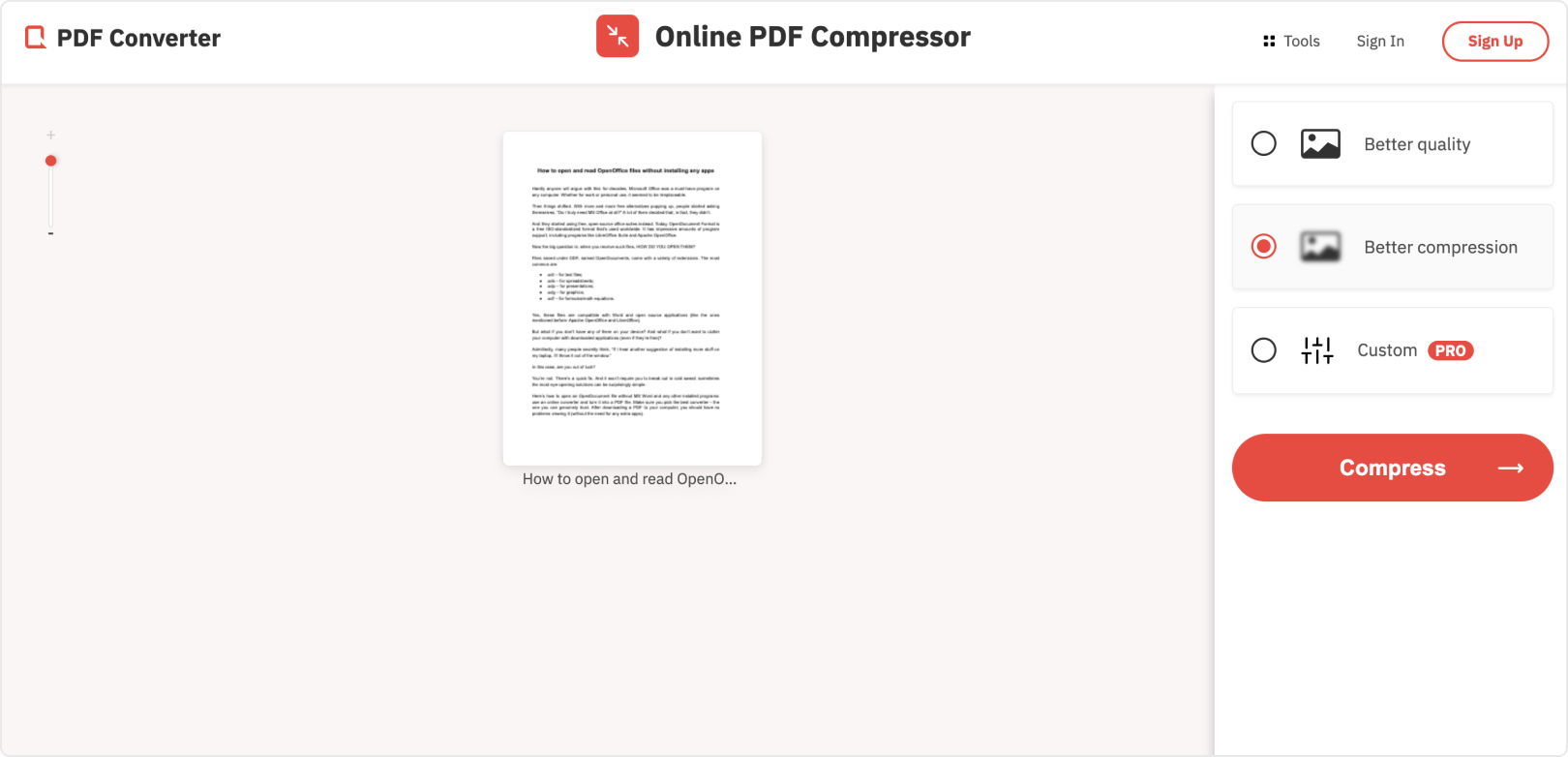
The compressor finds redundant data and oversized images inside the file and rewrites them more efficiently, so the document still looks sharp on screen. Uploaded files are deleted from our servers after processing, which keeps your information private.
How to zip a PDF
Another common approach is to pack the PDF into a .ZIP archive. Zipping is built into Windows and macOS and is handy when you need to send several files at once. Here is how to zip a PDF on Windows:
- Put the PDF (or several PDFs) into a new folder.
- Right-click the folder.
- Select "Send to" and then "Compressed (zipped) folder".
- A new .ZIP file appears next to the folder, ready to attach to an email.
On a Mac, right-click the file or folder in Finder and choose "Compress". The recipient downloads the .ZIP file and extracts it to get the original PDF back.

Disadvantages of zipping a PDF
- PDFs are already compressed internally, so zipping one rarely makes it much smaller. A 30 MB scan will usually still be too big for email after zipping.
- The recipient has to download and extract the archive before reading anything, which is an extra step, and a clumsy one on phones and tablets.
- Some corporate mail servers block .ZIP attachments outright for security reasons.
Compress a PDF with Adobe Acrobat Pro
If you already pay for Adobe Acrobat Pro, it can reduce the file size directly:
- Open the PDF in Adobe Acrobat.
- Click "Tools" and then "Optimize PDF".
- Choose "Reduce File Size" from the toolbar.
- Save a copy of the PDF.
The result is good, but Acrobat Pro requires a paid subscription, so this route only makes sense if you use its other features too.
Which method should you pick?
For a single PDF that needs to get under an email size limit, online compression is the fastest route and keeps the file readable everywhere without extra steps. Zipping helps mainly when you are bundling many files together, and Acrobat is fine if you already own it. Fighting an email attachment limit specifically? See our guide on what to do when a PDF is too large to email.